


I’ve dealt with migraines for most of my adult life, those deep, pulsating headaches that don’t just hurt, but consume your entire awareness. If you’ve ever had a real migraine, you know the difference: it’s not just “a bad headache.” It’s nausea, light sensitivity, sound sensitivity, pressure behind the eyes, and the need to retreat into a dark cave of silence.
For years, I tried everything, prescription medications, diet changes, hydration strategies, supplements, breathing techniques, meditation, blue-light protection glasses. Some helped a little. Some didn’t help at all. But at some point, I stumbled into something I had never even heard of at the time: craniosacral therapy (CST).
I’ll never forget the first time someone recommended it. I was describing my migraines to a massage therapist, and she said:
“Have you ever tried craniosacral therapy? It works with the nervous system in a very gentle way, some people get relief when nothing else works.”
At that point, I was willing to try anything once. I booked a session expecting… well, I wasn’t sure what I was expecting. Maybe something like a massage, where the therapist would press, knead, or manipulate the tissue around my head.
Instead, what I got was something completely different, and surprisingly powerful.
What Craniosacral Therapy Actually Is (In Plain Language)
Table of Contents
- 1 What Craniosacral Therapy Actually Is (In Plain Language)
- 2 My First Session: The Skeptic Becomes Curious
- 3 The Science Behind It, What Might Be Happening?
- 4 Is CST a Cure for Migraines?
- 5 What Sessions Feel Like Emotionally and Physically
- 6 Who Might Benefit from CST?
- 7 How Often Should You Do It?
- 8 Limitations and Realistic Expectations
- 9 The Takeaway, Does Craniosacral Therapy Work for Migraines?
If you’re not familiar with CST, here’s how I describe it to people now:
It’s an extremely light-touch therapy focused on relaxing the central nervous system by working with subtle rhythms and tissue tensions around the skull, spine, and sacrum (tailbone). The therapist uses a touch that’s sometimes so delicate you barely feel it, which sounds unbelievable, because migraines feel anything but subtle.
But CST doesn’t attack the pain, it calms the nervous system that produces the pain.
The theory behind CST is that our cranial bones, connective tissues, cerebrospinal fluid, and neural pathways have their own rhythm. When tension builds up in those areas, especially around the membranes of the brain and spinal cord, that can contribute to migraines.
Instead of forcing anything, CST therapists listen with their hands, which sounds poetic, but I’ve literally felt it happening.
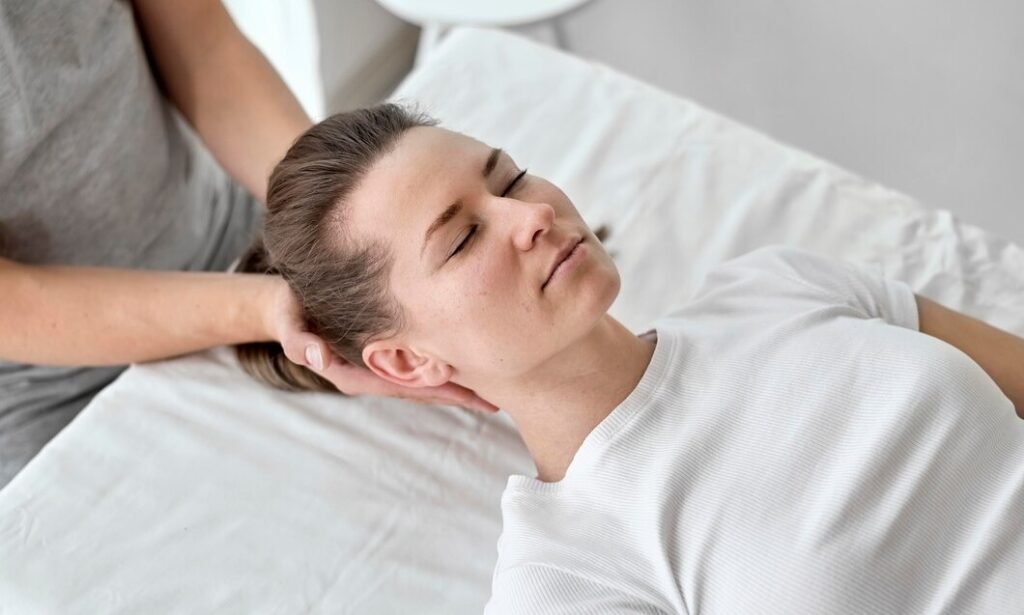
During a session, the practitioner may place their fingers lightly:
- at the base of my skull
- on the sides of my head
- over my forehead
- beneath the lower back
- along the spine
- gently holding the sacrum
It’s not about physical manipulation, it’s more like nervous-system tuning.
My First Session: The Skeptic Becomes Curious
When I arrived for my very first session, I remember thinking:
“There’s no way this feather-light touching is going to do anything for a migraine.”
I laid down fully clothed on the treatment table. The therapist placed her hands under my head, barely touching. After a few minutes, something strange happened: my breathing slowed down, and I felt a deep sense of quiet that I wasn’t accustomed to, the kind of stillness you might feel right before falling asleep.
Then something even stranger happened.
I felt a sensation almost like my skull was expanding from the inside, like pressure was dissolving. It wasn’t dramatic. It wasn’t painful. It was like a slowly melting ice cube, deep inside my head.
After the session, I expected my migraine to still be there. But it had noticeably reduced from a sharp stabbing pulse to a dull, manageable heaviness. I could open my eyes without stabbing light sensitivity. I could speak. I even felt like I could function socially.
The real surprise was the following morning, I woke up without a residual migraine “hangover.” That hadn’t happened in years.
That was the moment I went from skeptic to genuinely intrigued.
The Science Behind It, What Might Be Happening?
I’m not a doctor, and I can’t give medical advice, but I’ve spent time researching CST after my experience, trying to understand why it helped me.
Here are some possible explanations:
1. CST calms the autonomic nervous system
Migraines are closely linked to the sympathetic system, the “fight or flight” response. CST shifts the body toward parasympathetic dominance, the “rest and digest” state. When you’re in that calmer neurological mode, the brain and cranial tissues can decompress and rebalance.
2. It improves cerebrospinal fluid dynamics
CST proponents say it encourages more balanced fluid movement around the brain and spinal cord. If pressure is building in these membranes, this could relieve that strain.
3. It releases fascial restrictions
Fascia, the connective tissue that envelops everything in the body, can hold tension. CST helps the fascia around the skull and spine relax.
4. It reduces emotional tension held physically
This is real in ways most people underestimate. Stress doesn’t “live in the mind.” It lives in muscles, membranes, posture, breath. CST may allow those emotional-physical knots to unwind.
Is CST a Cure for Migraines?
I wouldn’t call it a “cure.” For me, CST is part of a migraine-management toolkit, not a magic switch.
Here’s what I’ve personally noticed after multiple sessions:
- My migraines occur less frequently
- When they do happen, they’re less severe
- They resolve faster
- I have far fewer days lost to headache recovery
- I feel more aware of when a migraine is coming, and can respond earlier
- My overall stress and tension levels are lower
Is it consistent? For me, yes. Is it instant for everyone? Probably not.
Migraines are complex and personal, some are triggered by sleep disruption, some by hormones, some by neck tension, some by histamines, some by light sensitivity, some by food chemicals, some by stress.
For many people, it’s a multifactorial condition.
What Sessions Feel Like Emotionally and Physically
Some sessions are deeply relaxing, I start drifting off, breathing slow and deep, almost like in a meditative state.
Other sessions have surprised me with emotional releases. On two occasions, I unexpectedly teared up, not from sadness, but from some stored tension I didn’t even realize I was holding. It felt cathartic.
Once, I experienced a sudden sensation like a release behind my eyes, almost like a pressure valve opening.
Another time, I felt warmth draining down my spine.
Again, this isn’t a dramatic “chiropractic crack” type sensation. It’s subtle. But your body notices.
Who Might Benefit from CST?
Based on what I’ve experienced and what other migraine sufferers have told me, CST might be helpful for people whose migraines are influenced by:
- jaw tension (TMJ)
- neck tightness
- posture strain
- stress + anxiety
- head/neck trauma
- nervous system sensitivity
- connective tissue tension
- sleep disruption
- hormonal shifts with stress
- long-term chronic tension patterns
People with migraines caused strictly by specific vascular conditions or neurological disorders may or may not respond the same way, but CST still often supports general nervous-system regulation.
How Often Should You Do It?
For me, these are patterns that worked:
- During high-migraine periods: 1x/week
- During stabilization phase: 1x every 2–3 weeks
- Maintenance/prevention mode: 1x/month or when I feel an early warning sign coming
Your body will tell you what rhythm works.
Limitations and Realistic Expectations
Craniosacral therapy is not:
- a replacement for medical diagnostics
- a guaranteed solution
- a pain-blocking pill
- an emergency-intervention treatment
It is:
- gentle
- supportive
- calming
- noninvasive
- neurologically soothing
- helpful as a complementary therapy
I still hydrate well. I still monitor screen time. I still try to maintain good sleep hygiene. I still manage stress levels consciously.
CST became a powerful addition, not a sole answer.
The Takeaway, Does Craniosacral Therapy Work for Migraines?
For me, the answer is yes, with emphasis on for me.
It hasn’t eliminated migraines entirely, but it has changed:
- the frequency
- the intensity
- the duration
- and my relationship to them
Before CST, migraines felt like a battle against my own head.
After CST, they feel like signals from my nervous system, alerts that something needs adjustment, attention, rest, or release.
CST gave me a sense of agency.
It gave me tools.
It reminded me that my nervous system is not my enemy.
Read the latest wellness articles on MassageProGuide to discover trusted therapies, product reviews, and expert-backed pain relief insights.
